


How to Build a High-Converting Business Website in 2026
A business website should do more than display your company name, services, images, and contact information.
It should help visitors understand your value, trust your business, and take the next step.
That next step could be:
- Calling your business
- Filling out a form
- Booking an appointment
- Requesting a quotation
- Starting a WhatsApp conversation
- Purchasing a product
- Downloading a resource
This is what makes a website conversion-focused.
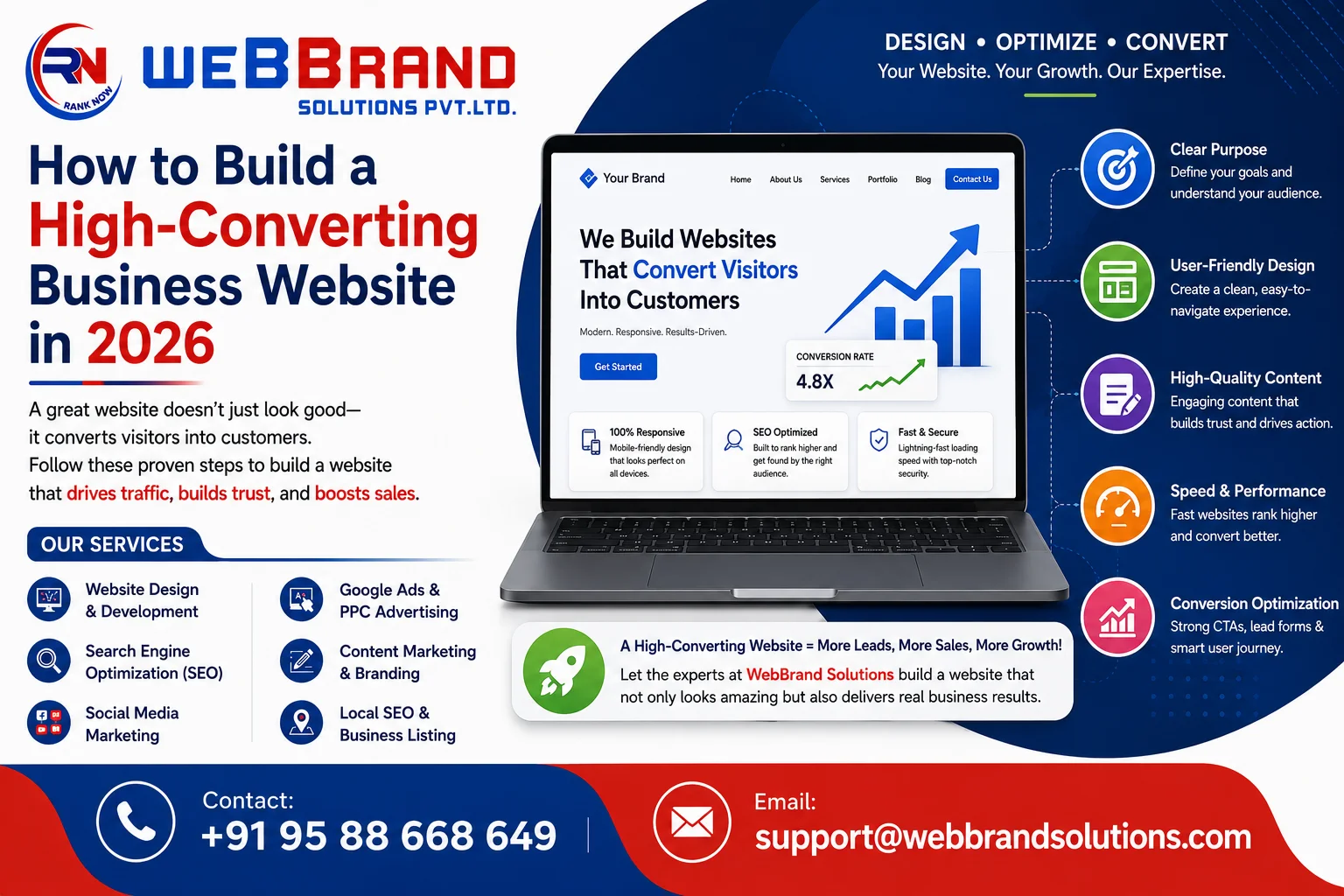
In 2026, businesses need websites that combine professional design, SEO, performance, mobile usability, persuasive content, trust signals, analytics, and clear calls to action.
So how do you build a website that actually generates business?
Let’s break it down.
What Is a High-Converting Website?
1. One of the biggest mistakes businesses make is starting website development with design alone.
Before choosing:
- Colors
- Fonts
- Animations
- Sliders
- Images
define your business objectives.
For example:
A B2B company
Goal: generate qualified leads.
Primary CTA:
Talk to Our Team
The design should support the objective.
2. Create a Clear Homepage
Your homepage should not make visitors work to understand your business.
A practical structure could be:
Hero section
What you do + who you help + primary CTA
↓
Trust section
Clients, certifications, experience, reviews, awards, or other legitimate credibility signals
↓
Services/products
Clear explanation of your main offerings
↓
Why choose us
Differentiators supported by evidence
↓
Process
Explain how working with you works
↓
Case studies/projects
Show real work where appropriate
↓
Testimonials
Use genuine customer feedback
↓
FAQs
Answer common questions
↓
CTA
Tell visitors what to do next
This structure is not mandatory for every business, but it provides a useful starting framework.
3. Design for Mobile First
A website can look excellent on a large desktop monitor and still provide a poor experience on mobile.
Visitors should be able to:
- Read content comfortably
- Tap buttons easily
- Navigate menus
- View images
- Complete forms
- Call the business
- Contact the business
without excessive zooming or horizontal scrolling.
Google’s page-experience guidance recommends that content display well on mobile devices and emphasizes an overall good page experience.
4. Use Clear Calls to Action
A CTA should tell the visitor what happens next.
Weak:
Submit
Better:
Request a Free Consultation
Weak:
Click Here
Better:
Get a Project Quote
Weak:
Contact
Better:
Talk to Our Website Expert
The CTA should match the visitor’s intent and the stage of the customer journey.
5. Build Trust Before Asking for the Sale
Visitors may not know your business.
Trust signals can reduce uncertainty.
Depending on your industry, consider:
- Customer testimonials
- Case studies
- Client logos where permitted
- Certifications
- Industry experience
- Team information
- Business address
- Contact details
- Guarantees where genuinely offered
- Reviews
- Before-and-after examples
- Project results
But avoid creating fake reviews or unsupported claims.
Google’s people-first guidance emphasizes demonstrating real expertise and depth of knowledge.
6. Create Dedicated Service Pages
One of the most common website mistakes is putting every service on a single page.
Suppose a digital marketing company offers:
- SEO
- PPC
- Social media marketing
- Website design
- Content marketing
Instead of explaining everything in one giant block, create dedicated service pages.
For example:
/seo-services/
/google-ads/
/social-media-marketing/
/website-design/
Each page can address:
- What the service is
- Who needs it
- Benefits
- Process
- Deliverables
- FAQs
- Examples
- Relevant CTAs
This also gives your SEO strategy more relevant landing pages.
7. Write Content for Customers, Not Just Search Engines
SEO is important, but your website should ultimately communicate with people.
Google’s guidance recommends creating helpful, reliable, people-first content rather than content primarily created to manipulate search rankings.
Instead of writing:
“We are the best best best website company providing the best website services…”
write:
“We design responsive business websites that help companies explain their services, generate enquiries, and provide customers with an easy way to contact them.”
The second version communicates value.
8. Make Your Website Search-Friendly
A high-converting website still needs to be discoverable.
Important SEO foundations include:
- Crawlable pages
- Indexable content
- Descriptive titles
- Relevant headings
- Internal links
- Search-intent alignment
- Optimized images
- Mobile-friendly design
- HTTPS
- Good page experience
- Useful content
Google’s technical requirements state that pages need to be accessible to Googlebot, return a successful HTTP response, and contain indexable content to be eligible for indexing.
Eligibility does not guarantee ranking, but technical accessibility is foundational.
9. Use Internal Linking Strategically
Internal links help users move between related pages.
For example:
Homepage
SEO Services
SEO Blog
Contact
This creates a logical customer journey.
A blog article about website speed could link to:
- Web development
- Technical SEO
- Website optimization
- Contact page
Internal links should be useful rather than inserted purely for keyword manipulation.
10. Make Forms Simple
A form should ask only for information you genuinely need.
Instead of asking for:
- Full name
- Company name
- Job title
- Address
- City
- State
- Website
- Budget
- Industry
- Multiple questions
consider whether every field is necessary.
A simple enquiry form might need:
Name
Phone/email
Requirement
Submit
The exact fields depend on your sales process.
11. Add WhatsApp and Other Contact Options Carefully
For businesses serving customers through WhatsApp, a clearly visible WhatsApp CTA can make contacting the company easier.
You can provide:
Chat on WhatsApp
alongside:
- Phone
- Contact form
- Appointment booking
However, avoid covering the entire screen with floating widgets or intrusive popups.
Good UX should make contacting you easier—not make browsing difficult.
12. Make Your Website Fast
Beautiful design should not come at the cost of usability.
Google recommends good Core Web Vitals and a strong overall page experience. Its current Core Web Vitals guidance identifies LCP, INP, and CLS as key metrics.
During development:
- Compress images
- Optimize scripts
- Reduce unnecessary plugins
- Use caching
- Optimize fonts
- Minimize layout shifts
- Test mobile performance
Performance should be considered during development—not after launch.
15. Add FAQs
FAQ sections are useful because they address objections before users contact you.
Examples:
How much does a business website cost?
How long does website development take?
Will my website be mobile-friendly?
Can you redesign my existing website?
Will my website be SEO-friendly?
Can I update the website myself?
Do you provide website maintenance?
These questions can also support conversational search intent when answered clearly and accurately.
Website Design vs Website Development
These terms are sometimes used interchangeably, but they represent different areas.
Website design
Focuses on:
- Layout
- Visual hierarchy
- Typography
- Colors
- User interface
- User experience
Website development
Focuses on:
- Functionality
- CMS
- Integrations
- Forms
- Ecommerce
- APIs
- Database functionality
- Performance
- Technical implementation
A strong project needs both.
What Makes a Website SEO-Friendly and Conversion-Friendly?
The ideal website combines both objectives.
SEO asks:
Can search engines understand and discover this page?
Conversion optimization asks:
Can visitors understand the value and take action?
A website that ranks but does not convert wastes traffic.
A beautiful website that nobody can discover also wastes its potential.
The best approach connects:
SEO + UX + Content + Performance + Conversion + Analytics
Frequently Asked Questions (FAQs)
- What makes a business website successful?
A successful business website clearly communicates what the company offers, builds trust, provides a good user experience, attracts relevant visitors, and makes it easy for visitors to take meaningful actions. - How many pages should a business website have?
There is no universal number. A small business may need only a handful of well-designed pages, while a larger company may need dozens or hundreds. The important factor is whether each page serves a genuine user or business purpose. - Should every business website have a blog?
Not necessarily. A blog can be valuable when a business has useful information to share and can maintain quality content. Content should serve customers rather than exist solely to increase page count. - How important is mobile-friendly website design?
Very important. Customers increasingly interact with businesses through mobile devices, and Google recommends that websites provide a good mobile experience. - Should I redesign my existing website?
Consider a redesign when the current website is outdated, difficult to use, slow, not mobile-friendly, difficult to update, poorly optimized for search, or failing to generate the desired business outcomes. - How long does it take to build a business website?
The timeline depends on the number of pages, design complexity, functionality, content, integrations, feedback cycles, and technical requirements. A simple brochure website and a complex ecommerce platform require very different development timelines.
Conclusion
Your website should not simply be your company’s online brochure.
It should be a digital business asset that attracts visitors, communicates value, builds trust, and encourages action.
The best websites in 2026 combine:
Professional design + useful content + SEO + performance + mobile UX + conversion optimization + analytics.
If your current website looks good but does not generate enough enquiries, the problem may not be your traffic alone.
The real opportunity could be the experience visitors receive after they arrive.
Need a professional, SEO-friendly and conversion-focused business website? Talk to WebBrand Solutions about creating or redesigning a website built around your business goals.