


AI Agents in Digital Marketing: How Autonomous Marketing Is Changing Business in 2026
Digital marketing is entering a new phase.
For years, businesses used software to schedule social media posts, automate emails, analyze website traffic, manage advertisements, and generate content.
Then generative AI changed how marketers create.
Now another shift is taking place:
AI is moving from simply creating content to helping plan, execute, analyze, and optimize marketing activities.
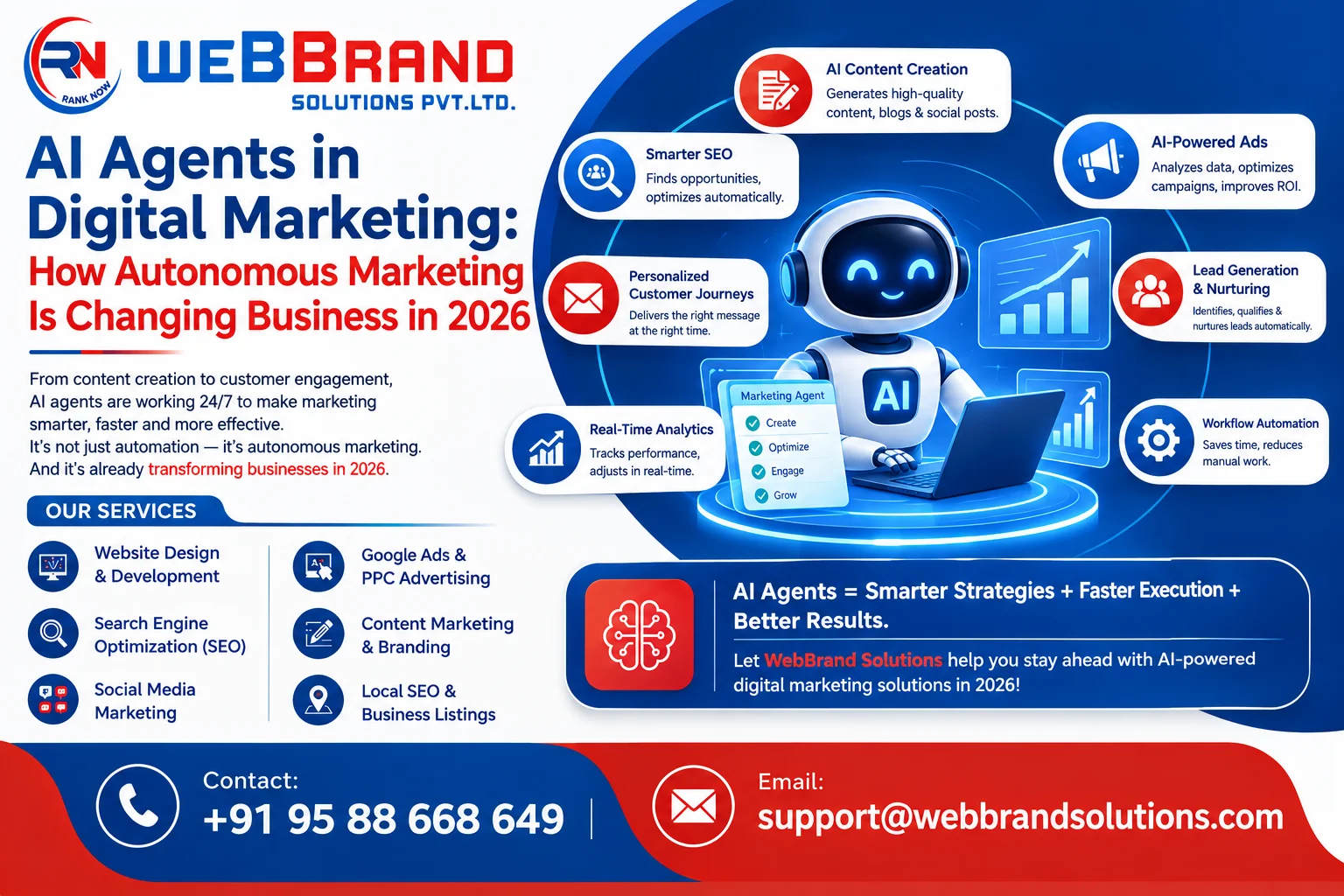
This is where AI agents enter the picture.
Instead of asking an AI tool to write one social media post, marketers can increasingly use AI-powered systems to perform a sequence of tasks—such as analyzing campaign data, identifying opportunities, generating creative variations, suggesting audiences, and helping optimize campaigns.
Meta, for example, has been expanding AI capabilities across advertising and business tools, while its 2026 marketing research highlights AI, short-form video, creators, and messaging as major forces shaping customer discovery and commerce in India.
So what exactly are AI agents, and what do they mean for businesses?
What Are AI Agents in Digital Marketing?
AI agents are AI-powered systems designed to understand a goal, make decisions within defined boundaries, use available tools or data, and perform multiple steps toward completing a task.
A traditional AI tool might respond to:
“Write five Instagram captions for a digital marketing agency.”
An AI agent could potentially work toward a broader goal such as:
“Help increase qualified leads from Instagram.”
Depending on the tools and permissions available, that workflow could involve:
- Researching the target audience
- Reviewing previous content performance
- Identifying content opportunities
- Creating content ideas
- Generating drafts
- Preparing variations
- Analyzing performance
- Recommending improvements
The important difference is workflow and goal orientation, not simply content generation.
Why AI Agents Are Becoming Important in Marketing
Marketing teams already manage a large number of repetitive activities.
For example:
- Keyword research
- Competitor research
- Content planning
- Social media scheduling
- Ad analysis
- Email segmentation
- Lead qualification
- Reporting
- Customer follow-ups
- Creative testing
- Data analysis
AI can help automate parts of these workflows.
HubSpot’s 2026 State of Marketing research identifies AI-powered personalization and automation among the leading trends marketers are adopting, while also highlighting the need to adapt content and SEO for changing search behavior.
The potential benefit is not simply:
“AI does the marketer’s job.”
A better way to think about it is:
AI handles more repetitive work so marketers can spend more time on strategy, creativity, customer understanding, and decision-making.
AI Agents vs Generative AI: What's the Difference?
These terms are often confused.
Generative AI
Generative AI can create:
- Text
- Images
- Videos
- Audio
- Ideas
- Summaries
- Code
For example:
“Create a 500-word blog introduction about SEO.”
The AI generates the requested content.
AI Agent
An AI agent is designed around a broader task or objective.
For example:
“Analyze our last month’s SEO performance and identify the top five opportunities for increasing qualified organic traffic.”
An agentic workflow could potentially:
- Access approved data
- Analyze it
- Identify patterns
- Compare performance
- Produce recommendations
- Present the findings
The exact capabilities depend on the tools, integrations, permissions, and system design.
So:
Generative AI = create
AI agent = plan + act across multiple steps within defined boundaries
The distinction is useful, although modern AI products increasingly combine both approaches.
What Does This Mean for SEO, AEO and GEO?
Digital marketing is becoming more multi-layered.
SEO
Focuses on visibility in search engines and organic search results.
AEO
Focuses on providing clear answers that can be understood and surfaced by answer-oriented search experiences.
GEO
The term is increasingly used for strategies aimed at improving visibility in generative AI search experiences.
But businesses should avoid treating GEO as a collection of tricks.
The fundamentals still matter:
- Accurate information
- Useful content
- Clear structure
- Original insights
- Strong topical coverage
- Good technical SEO
- Credible sources
- Real expertise
The objective is not:
“How do I trick AI into mentioning my business?”
It should be:
“How do I become a genuinely useful and credible source of information?”
What Skills Will Digital Marketers Need in 2026?
AI changes the skills marketers need.
Instead of only learning how to use individual tools, marketers increasingly need to understand systems.
Important skills include:
- AI literacy
Understanding what AI can and cannot do. - Prompt and workflow design
Knowing how to give AI useful instructions and structure multi-step tasks. - Data analysis
Understanding marketing metrics rather than simply generating reports. - SEO and search strategy
Understanding traditional search as well as changing AI search experiences. - Content strategy
Knowing what information customers actually need. - Creative thinking
Developing ideas that are difficult to commoditize. - Automation
Connecting marketing tools and reducing repetitive processes. - Brand strategy
Maintaining a consistent identity across AI-assisted content.
Frequently Asked Questions (FAQs)
- What are AI agents in digital marketing?
AI agents are AI-powered systems that can work toward defined marketing goals by performing multiple steps, using available information and tools, and assisting with tasks such as research, analysis, content workflows, campaign optimization, and lead management. - Are AI agents replacing digital marketers?
AI is increasingly automating and assisting parts of marketing work, but human strategy, creativity, judgment, brand understanding, and customer relationships remain important. The practical opportunity is often to combine AI capabilities with human expertise. - How can AI agents help with SEO?
AI-assisted workflows can help with keyword research, content planning, competitor analysis, internal-link suggestions, content updates, technical issue identification, and performance analysis. Human review should remain part of the process. - Will AI replace SEO?
AI is changing how people search and how marketers approach SEO, but businesses still need discoverable, technically accessible, useful, and trustworthy websites. Google continues to emphasize people-first content and fundamental SEO practices. - What is AEO?
AEO, or Answer Engine Optimization, generally refers to structuring and creating content so that answer-oriented search systems can understand and potentially surface clear answers. - What is GEO in digital marketing?
GEO is commonly used to describe strategies intended to improve a brand’s visibility in generative AI search experiences. It should be approached as an extension of useful content, search visibility, authority, and clear information rather than as a shortcut or ranking trick. - How can small businesses use AI in marketing?
Small businesses can begin with repetitive, low-risk activities such as content ideation, reporting, research, data summarization, social media planning, and lead organization. Start with one workflow, measure the results, and expand gradually. - Is AI-generated content good for SEO?
AI can assist with content creation, but automatically generated content is not inherently valuable. Content should be accurate, useful, original where appropriate, and created primarily to help people. Google’s guidance emphasizes people-first content rather than content produced primarily to manipulate search rankings.
Conclusion: The Future of Digital Marketing Is AI-Powered, But Human-Led
Digital marketing is changing quickly. AI is moving beyond simple content generation. Search is becoming more conversational. Social platforms are becoming discovery and commerce channels. Messaging is becoming an important part of customer journeys. Advertising platforms are using increasingly sophisticated AI systems, and marketers are beginning to connect these technologies into larger workflows.
But businesses should not adopt AI simply because it is trending.
The better question is:
Can this technology help us understand customers better, work more efficiently, create better experiences, or generate better business results?
That is where AI becomes useful.
The future of digital marketing is unlikely to be about choosing between humans and AI.
It is about building a smarter system where technology handles repetitive work and data-heavy tasks while people provide strategy, creativity, expertise, trust, and judgment.
At WebBrand Solutions, we help businesses build their digital presence through SEO, website design and development, digital marketing, paid advertising, social media, analytics, and performance-focused strategies. If your business is still using a traditional digital marketing approach, 2026 is a good time to evaluate where AI, automation, search optimization, content, and digital experiences can work together.
Want to build a modern digital marketing strategy for your business? Contact WebBrand Solutions and let’s turn your digital presence into a system designed for sustainable growth.