



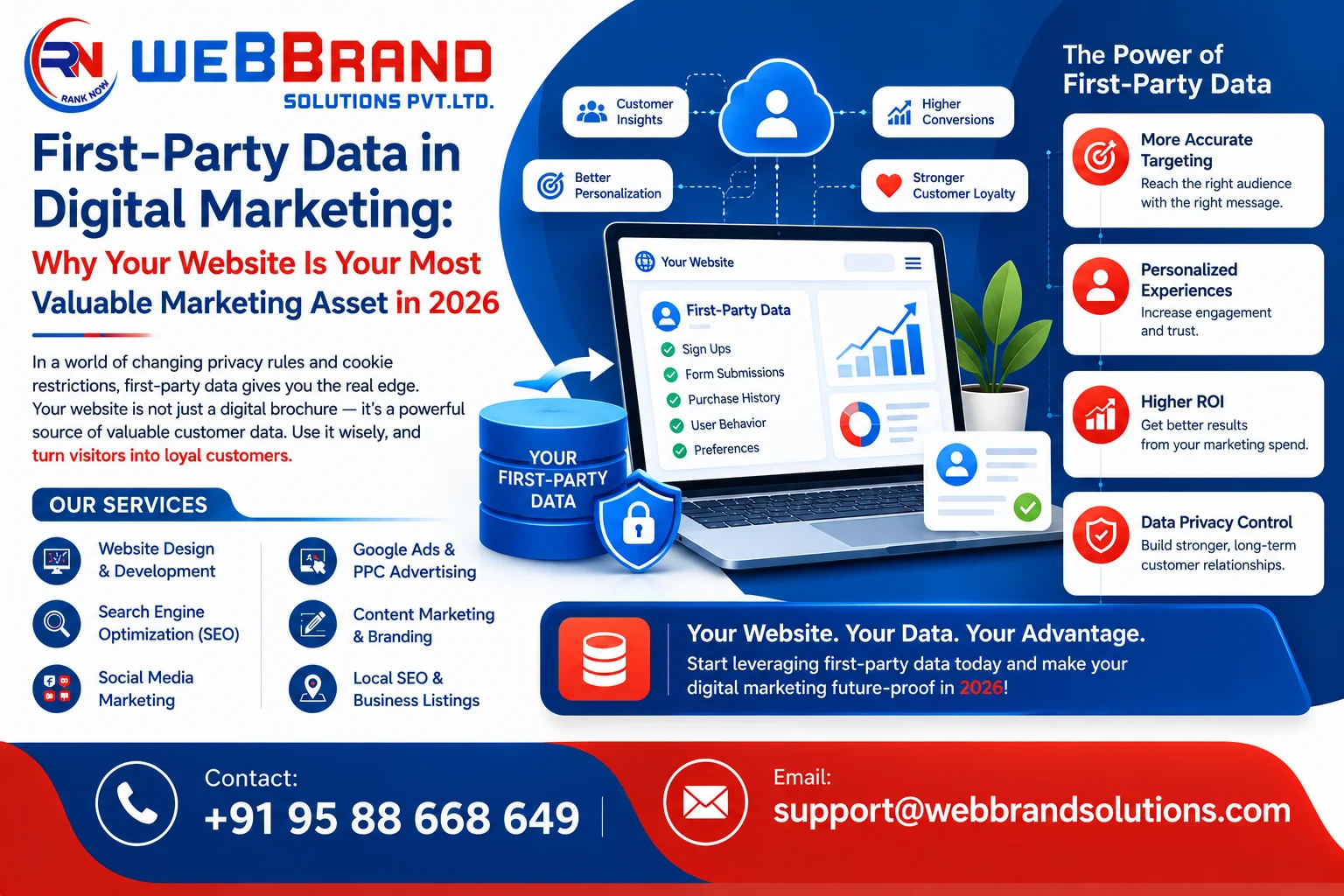
First-Party Data in Digital Marketing: Why Your Website Is Your Most Valuable Marketing Asset in 2026
Digital marketing is changing rapidly. AI-powered search, privacy concerns and rising advertising costs are making it more important for businesses to understand their own customers.
This is where first-party data becomes valuable.
Instead of relying only on advertising platforms and third-party data, businesses can use information collected directly through their websites, customer interactions, enquiry forms and purchases—with appropriate consent.
In 2026, your website is more than an online presence. It can become a powerful asset for understanding customers, generating qualified leads and building long-term business relationships.
What Is First-Party Data?
First-party data is information a business collects directly from its audience through its own channels, such as its website, app, CRM, email subscriptions, purchases and customer interactions.
Examples include:
- Website enquiries and contact form submissions
- Products or services customers show interest in
- Newsletter subscriptions
- Purchase and order history
- Customer preferences shared with your business
- Website conversions and engagement data collected with appropriate consent
Unlike purchased third-party audience data, first-party data comes directly from interactions between your business and its audience.
Why Is First-Party Data Important in 2026?
Businesses need better ways to understand customers and measure marketing performance. First-party data can help them do this while reducing dependence on external audience data.Here are three key benefits:
1. Better audience understanding: Learn which services customers explore, which pages attract attention and what questions they ask.
2. Smarter marketing decisions: Connect website enquiries and conversions with marketing campaigns to understand which channels contribute to business results.
3. More relevant customer experiences: Use information customers have shared to deliver useful, personalized communication with appropriate consent.
First-party data does not automatically improve results. Its value depends on data quality, proper measurement and how effectively a business uses it.
How Can Your Website Help You Collect First-Party Data?
Your website can become the central point of your data collection strategy.
1. Use Smart Enquiry Forms
Ask visitors for relevant information, such as their business type, service requirements or preferred contact method. Keep forms short and explain why the information is needed.
2. Set Up Website Analytics
Tools such as Google Analytics 4 and Google Search Console can help you understand website traffic, search visibility and engagement. Configure analytics and tracking according to applicable consent and privacy requirements.
3. Connect Your Website to a CRM
A customer relationship management (CRM) system can organize enquiries, lead sources, follow-ups and sales progress, helping your team understand the customer journey.
4. Create Valuable Content
Publish helpful blogs, guides, checklists and resources that answer customer questions. Relevant calls to action can encourage interested visitors to subscribe, request a consultation or contact your business.
5. Build Permission-Based Email Lists
Offer useful updates and resources in exchange for voluntary subscriptions. Send relevant communications and provide clear unsubscribe options.
First-Party Data, SEO and AI Search: How Are They Connected?
SEO, Answer Engine Optimization (AEO) and Generative Engine Optimization (GEO) focus on making your business and content discoverable across search experiences.
First-party data supports these strategies by helping you understand what your audience needs.
For example, website enquiries may reveal recurring questions about SEO pricing, website development timelines or digital marketing results. Your team can use these insights to create useful articles, detailed service pages and FAQs.
This creates a practical cycle:
Customer Questions → Useful Content → Search Visibility → Website Visits → Qualified Enquiries → Better Customer Insights
Remember, first-party data is not a direct ranking factor by itself. Its value lies in helping you create more relevant content, measure outcomes and improve customer experiences.
First-Party Data vs Third-Party Data
| First-Party Data | Third-Party Data |
|---|---|
| Collected directly by your business | Obtained from external providers or data aggregators |
| Based on your own customer interactions | May cover audiences with whom you have no direct relationship |
| Can support personalized customer experiences | May offer broader audience insights |
| Requires responsible storage and use | Also requires careful privacy and compliance checks |
For many businesses, building a reliable first-party data strategy is a practical way to develop stronger customer relationships and improve marketing measurement.
Common First-Party Data Mistakes to Avoid
- Collecting more personal information than necessary
- Using tracking technologies without addressing applicable consent requirements
- Keeping inaccurate or duplicate customer records
- Sending marketing messages without the required permission
- Treating website traffic as more important than qualified leads
- Collecting data without a clear plan for using it
The goal is not to collect as much data as possible. It is to collect useful information responsibly and turn it into better customer experiences.
Frequently Asked Questions (FAQs)
- What is first-party data in digital marketing?|
First-party data is information a business collects directly from its audience through channels such as its website, CRM, subscriptions, customer enquiries and purchases. - Why is first-party data important for businesses in 2026?
It can help businesses understand customer needs, measure marketing performance, personalize communication and reduce reliance on external audience data. - How can a website collect first-party data?
A website can collect relevant information through enquiry forms, newsletter subscriptions, customer accounts, purchases and consent-aware analytics, supported by appropriate privacy disclosures. - Does first-party data improve SEO rankings?
First-party data is not a direct Google ranking factor. However, it can reveal customer questions and content opportunities, helping businesses create more useful content and measure organic search performance. - What tools can businesses use to manage first-party data?
Depending on their needs, businesses can use Google Analytics 4, Google Search Console, CRM platforms, email marketing tools and ecommerce analytics. The tools should be configured with appropriate privacy safeguards.
Conclusion: Make Your Website Work Beyond Visibility
In 2026, a successful website should do more than attract visitors. It should help your business understand customer needs, generate qualified enquiries and measure marketing performance.
By combining SEO, useful content, website analytics, conversion tracking and CRM integration, businesses can turn their websites into valuable long-term marketing assets.
At WebBrand Solutions, we help businesses strengthen their online presence through SEO, website design and development, and digital marketing strategies focused on measurable growth.
Want to turn your website into a stronger lead-generation and marketing asset? Contact WebBrand Solutions to build a website and digital strategy around your business goals.