



AI in Digital Marketing: How Artificial Intelligence Is Transforming SEO, Content, Advertising & Lead Generation in 2026
Digital marketing is changing rapidly and Artificial Intelligence (AI) has become one of the most important technologies shaping the future of online business growth. From generating content and analyzing customer behaviour to optimizing SEO campaigns and improving advertising performance, AI is helping businesses make faster, smarter and more data-driven marketing decisions.
For businesses competing in Pune, PCMC, Maharashtra and across India, adopting AI in digital marketing is no longer simply about following a technology trend. It is becoming an important part of building an efficient, scalable and competitive digital marketing strategy.
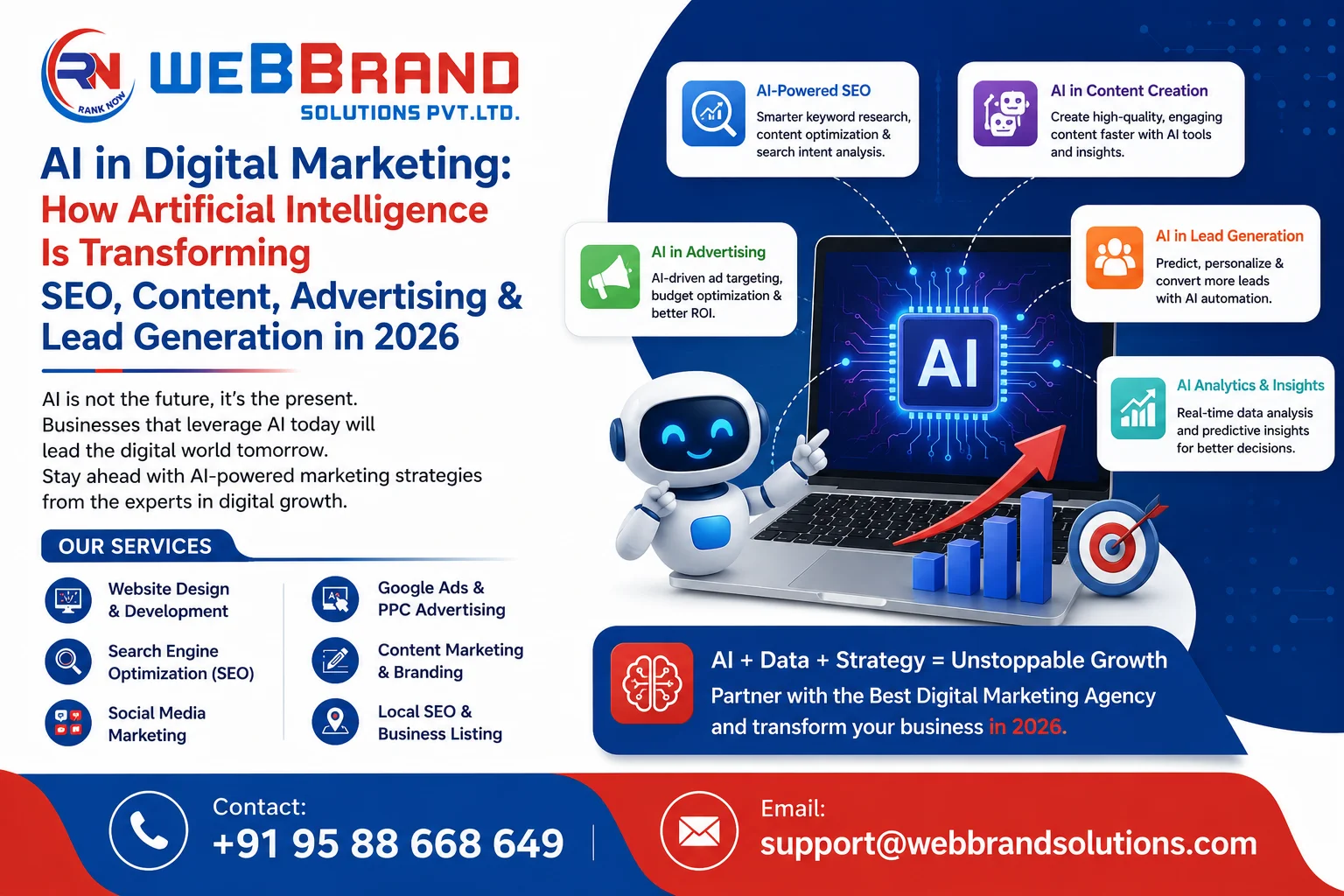
Traditional digital marketing strategies often require marketers to manually analyze large amounts of data, create content, identify customer segments, monitor campaigns and optimize advertisements. AI can assist with many of these tasks by processing information quickly, identifying patterns, automating repetitive activities and providing insights that can support better decision-making.
A Top Digital Marketing Agency in PCMC can use AI alongside human creativity and marketing expertise to improve SEO, content marketing, paid advertising, social media, lead generation and customer engagement.
Understanding how AI is transforming digital marketing can help businesses prepare for a more intelligent and competitive digital landscape.
What Is AI in Digital Marketing?
AI in digital marketing refers to the use of artificial intelligence technologies to analyze data, understand customer behaviour, automate marketing activities, personalize experiences and improve campaign performance.
AI can help marketers with activities such as:
- Keyword and search intent analysis
- Content ideation
- Content optimization
- Customer segmentation
- Lead scoring
- Chatbots and customer support
- Social media analysis
- Advertising optimization
- Predictive analytics
- Email personalization
- Marketing automation
- Competitor research
Instead of replacing marketers completely, AI can work as a powerful marketing assistant that helps teams save time and make more informed decisions.
For example, a digital marketing agency can use AI to identify patterns in website traffic, understand which content attracts users, analyze advertising campaigns and generate ideas for future marketing campaigns.
Why Is AI Important in Digital Marketing in 2026?
The amount of digital information generated by businesses and customers continues to grow. Marketers need to understand customer intent, identify opportunities, personalize communication and respond quickly to changing search behaviour.
AI makes it possible to analyze large amounts of information much faster than traditional manual processes.
For businesses, AI can provide several advantages:
- Faster Marketing Research
AI tools can assist marketers in analyzing keywords, competitors, customer interests, search trends and content opportunities.
- Improved Personalization
AI can analyze customer behaviour and help businesses deliver more relevant content, offers and messages to different audiences.
- Marketing Automation
Repetitive activities such as email sequences, customer responses, reporting and campaign monitoring can be partially automated.
- Better Decision-Making
AI can identify patterns in marketing data and provide insights that help marketers make more informed decisions.
- Improved Productivity
Instead of spending hours on repetitive tasks, marketers can use AI to accelerate research, content planning, reporting and campaign optimization.
How AI Is Transforming SEO
Search engine optimization is one of the areas experiencing major changes because of AI.
Search engines are becoming increasingly capable of understanding search intent, context, relationships between topics and the usefulness of content.
For businesses, this means SEO is moving beyond simply inserting keywords into webpages.
AI can assist SEO teams with:
- Keyword research
- Search intent analysis
- Topic clustering
- Content gap analysis
- Competitor analysis
- Internal linking suggestions
- Content optimization
- Technical SEO analysis
- SERP research
For example, instead of targeting only a keyword such as “digital marketing agency in PCMC,” marketers can use AI-assisted research to understand related topics, questions, services and user intentions surrounding that search.
This helps create more comprehensive content that answers the customer’s actual needs.
1. AI and Content Marketing
Content remains one of the most important components of digital marketing, but the way content is created is changing.
AI can help marketers generate:
- Blog topic ideas
- Content outlines
- Social media ideas
- Email concepts
- Ad copy variations
- Video scripts
- FAQs
- Product descriptions
However, businesses should not depend entirely on automatically generated content.
High-quality marketing content still requires:
- Human expertise
- Original insights
- Brand experience
- Accurate information
- Creativity
- Editing
- Fact-checking
- Customer understanding
The most effective approach is often AI-assisted content creation, where AI helps accelerate the process while human marketers provide strategy, expertise, originality and final quality control.
2. AI-Powered Personalization
Customers increasingly expect businesses to provide relevant experiences.
AI can analyze customer interactions and help marketers understand:
- What customers are searching for
- Which products they view
- Which pages they visit
- What content they engage with
- Which messages receive responses
- Which products may interest them
Businesses can then use these insights to personalize marketing communication.
For example, an e-commerce website can recommend products based on previous browsing behaviour, while a service company can show different content depending on the visitor’s interests.
Personalization can make digital marketing more relevant and improve the overall customer experience.
3. AI in Social Media Marketing
Social media marketers spend significant amounts of time researching trends, creating content, analyzing engagement and monitoring competitors.
AI can support these activities by helping marketers:
- Generate content ideas
- Analyze audience engagement
- Identify content trends
- Create captions
- Develop content calendars
- Analyze competitors
- Identify high-performing content
- Repurpose existing content
AI can also help businesses understand which types of posts generate stronger engagement.
However, successful social media marketing still requires authentic brand communication and human creativity. AI should support the strategy rather than make every piece of communication feel automated.
4. AI and Google Ads / Paid Advertising
Paid advertising generates large amounts of performance data.
AI can assist marketers in analyzing:
- Click-through rates
- Conversion rates
- Audience behaviour
- Search terms
- Ad performance
- Campaign trends
- Customer segments
AI-powered advertising systems can also help optimize campaigns based on available performance signals.
Marketers can use AI to create multiple ad variations, analyze campaign data, identify underperforming areas and generate ideas for testing.
The role of the marketer remains important because campaign objectives, budgets, brand positioning, creative strategy and business decisions still require human judgment.
5. AI for Lead Generation
Lead generation is another area where AI can provide significant value.
Businesses can use AI-powered systems to:
- Identify potential customers
- Score leads
- Qualify enquiries
- Automate initial conversations
- Personalize communication
- Analyze customer behaviour
- Recommend follow-up actions
For example, an AI chatbot on a website can answer frequently asked questions and collect basic customer information before passing qualified leads to the sales team.
This can help businesses respond to enquiries faster and reduce the amount of repetitive work handled manually.
6. AI Chatbots and Customer Support
Customers expect quick responses when they interact with businesses online.
AI-powered chatbots can assist with common questions such as:
- Business hours
- Product information
- Service details
- Pricing enquiries
- Appointment requests
- Order-related questions
- Basic support
A chatbot can operate outside traditional business hours and provide immediate responses to frequently asked questions.
However, complex or sensitive customer issues should still be transferred to human representatives.
The combination of AI automation and human support can provide a better customer experience.
7. AI and Email Marketing
Email marketing can become more effective when customer data is used intelligently.
AI can help marketers with:
- Subject line ideas
- Email content variations
- Customer segmentation
- Personalized recommendations
- Send-time analysis
- Campaign performance analysis
- Automated follow-up sequences
For example, different customer groups can receive different messages based on their interests or previous interactions.
This can make email marketing more relevant than sending the same message to every subscriber.
8. AI-Powered Customer Behaviour Analysis
Understanding customer behaviour is essential for successful digital marketing.
AI can analyze information from different digital touchpoints, including:
- Website visits
- Search behaviour
- Social media interactions
- Email engagement
- Advertising interactions
- Purchase history
These insights can help businesses understand customer journeys and identify opportunities for improvement.
For example, if many users visit a service page but leave without submitting an enquiry, marketers can investigate the page experience and identify potential conversion barriers.
9. AI in Marketing Analytics and Reporting
Digital marketing generates large amounts of data and understanding that data can be challenging.
AI can help marketers identify patterns and summarize campaign performance.
Marketing teams can use AI-assisted analytics to evaluate:
- Website traffic
- Leads
- Conversion rates
- Campaign performance
- Customer engagement
- SEO performance
- Advertising results
Instead of manually reviewing every data point, marketers can focus on the insights that matter most for business decisions.
Benefits of AI in Digital Marketing
Businesses adopting AI as part of their digital marketing strategy can benefit in several ways.
1. Saves Time
AI can automate or accelerate repetitive marketing tasks.
2. Improves Productivity
Marketing teams can spend more time on strategy, creativity and customer relationships.
3. Supports Better Decisions
AI can identify patterns in large amounts of marketing data.
4. Enables Personalization
Businesses can create more relevant experiences for different customer segments.
5. Improves Lead Management
AI can help identify and prioritize potential customers.
6. Supports Marketing Scalability
Businesses can produce and manage more marketing activities without increasing manual workload at the same rate.
7. Enhances Customer Experience
AI chatbots, recommendations, and personalized communication can improve customer interactions.
Common Mistakes Businesses Make When Using AI for Marketing
AI can be powerful, but businesses should avoid using it without a clear strategy.
1. Publishing AI-Generated Content Without Editing
Automatically generated content may contain inaccuracies, generic information, or messaging that does not match the brand.
Human review is essential.
2. Focusing Only on Quantity
Creating hundreds of low-value articles using AI does not automatically create a successful SEO strategy.
Quality, usefulness, relevance and originality remain important.
3. Ignoring Brand Voice
Every business has its own personality and communication style.
AI-generated content should be reviewed and adapted to match the brand.
4. Using AI Without Reliable Data
Poor-quality data can lead to poor insights.
Businesses should ensure that the information being analyzed is relevant and reliable.
5. Removing Human Interaction Completely
Customers still value human support, especially when dealing with complex problems.
AI should enhance human interaction rather than eliminate it unnecessarily.
6. Depending on a Single AI Tool
Different marketing activities may require different technologies.
Businesses should select tools according to their objectives instead of using one tool for everything.
AI vs Traditional Digital Marketing
AI does not necessarily replace traditional digital marketing. Instead, it changes how marketers execute traditional strategies.
| Traditional Digital Marketing | AI-Assisted Digital Marketing |
|---|---|
| Manual research | AI-assisted research |
| Manual data analysis | Automated data analysis |
| Generic campaigns | Personalized campaigns |
| Manual customer segmentation | AI-assisted segmentation |
| Manual reporting | Automated reporting |
| Standardized communication | Dynamic communication |
| Reactive decisions | Predictive insights |
| Repetitive tasks | Marketing automation |
The future of digital marketing is likely to combine human creativity, strategic thinking, marketing expertise and artificial intelligence.
Future of AI in Digital Marketing
AI is expected to play an increasingly important role in digital marketing.
Future marketing strategies may include greater use of:
- AI-powered search
- Predictive customer analytics
- Automated campaign optimization
- Personalized marketing experiences
- AI-assisted SEO
- Conversational search
- Intelligent chatbots
- Automated content workflows
- Predictive lead scoring
- Advanced customer journey analysis
As search engines and digital platforms become more intelligent, businesses will need to focus on providing accurate information, useful content, strong brand signals and positive customer experiences.
How a Digital Marketing Agency Can Help Businesses Adopt AI
Implementing AI successfully requires more than simply purchasing AI tools.
A professional digital marketing agency can help businesses determine:
- Which marketing tasks should be automated
- Which AI tools are appropriate
- How AI can support SEO
- How to improve content workflows
- How to use AI for lead generation
- How to analyze marketing performance
- How to maintain brand consistency
- Where human expertise is still required
A Top Digital Marketing Agency in PCMC can combine AI technologies with proven SEO, content marketing, social media, website development, paid advertising and lead-generation strategies.
How RN WebBrand Solutions Uses AI-Driven Digital Marketing Strategies
RN WebBrand Solutions helps businesses strengthen their online presence through digital marketing, SEO, website development, content marketing and performance-focused strategies.
By combining modern AI-assisted techniques with human marketing expertise, businesses can improve efficiency while maintaining a strong focus on quality and measurable outcomes.
The strategy can include:
- AI-Assisted SEO Research
Identifying search opportunities, related topics, search intent, and content gaps.
- AI-Assisted Content Strategy
Developing content ideas and structures based on customer needs and business objectives.
- Marketing Automation
Reducing repetitive tasks and improving marketing workflows.
- Lead Generation Optimization
Using data and automation to improve lead qualification and follow-up.
- Performance Analysis
Analyzing campaign and website data to identify opportunities for improvement.
- Human-Led Marketing Strategy
Using AI as a supporting technology while keeping strategic decisions, creativity, brand positioning, and quality control under human supervision.
Frequently Asked Questions (FAQs)
1. What is AI in digital marketing?
AI in digital marketing refers to using artificial intelligence technologies to analyze data, automate marketing tasks, understand customer behaviour, personalize communication and improve campaign performance.
2. How is AI changing digital marketing?
AI is changing digital marketing by improving automation, personalization, data analysis, content workflows, SEO research, advertising optimization and customer engagement.
3. Can AI replace digital marketers?
AI can automate many repetitive activities, but it does not completely replace the need for marketers. Strategy, creativity, brand understanding, decision-making and human communication remain important.
4. How can AI help with SEO?
AI can assist with keyword research, search intent analysis, competitor research, content optimization, topic clustering, content gaps and other SEO activities.
5. Can AI create digital marketing content?
Yes. AI can help generate ideas, outlines, drafts, captions, advertisements, emails and other marketing content. However, human editing, fact-checking, originality and strategic input remain important.
6. Is AI useful for small businesses?
Yes. Small businesses can use AI to automate repetitive tasks, improve customer communication, analyze marketing data, generate content ideas and improve marketing productivity.
7. How does AI help with lead generation?
AI can help businesses qualify leads, analyze customer behaviour, automate initial communication, personalize follow-ups and prioritize potential customers.
8. Is AI important for digital marketing in 2026?
Yes. AI is becoming an important part of modern digital marketing because businesses need to manage increasing amounts of data, content, customer interactions and digital competition.
9. Should businesses use AI-generated content for SEO?
Businesses can use AI to support content creation, but content should be useful, accurate, original, relevant to the audience and reviewed by humans rather than published automatically without quality control.
10. Why choose RN WebBrand Solutions for AI-driven digital marketing?
RN WebBrand Solutions combines digital marketing expertise with modern AI-assisted strategies to help businesses improve SEO, content marketing, lead generation, website performance and overall online visibility.
Conclusion
AI is transforming digital marketing by changing how businesses research, create, personalize, automate, analyze and optimize their marketing activities.
From AI-powered SEO and content marketing to automated lead generation, customer support, advertising and analytics, artificial intelligence provides businesses with new opportunities to improve efficiency and compete in an increasingly digital marketplace.
However, successful AI-driven marketing is not simply about replacing human work with automation. The strongest strategy combines artificial intelligence with human creativity, strategic thinking, marketing expertise and customer understanding.
For businesses in Pune, PCMC, Maharashtra and across India, adopting AI thoughtfully can create opportunities for better customer experiences, improved productivity, stronger digital visibility and sustainable growth.
With the right combination of AI technology and professional digital marketing expertise, businesses can stay prepared for the next generation of search, advertising, content and customer engagement.
RN WebBrand Solutions helps businesses explore modern digital marketing strategies that combine technology, creativity, SEO and performance-focused marketing to build a stronger online presence in the AI-driven digital landscape.