


Digital Marketing Automation in 2026: What Businesses Should Automate and What They Shouldn’t
Businesses today manage websites, SEO, social media, Google Ads, Meta Ads, email campaigns, lead enquiries, analytics, customer follow-ups, content and online reviews.
Doing everything manually can consume hours every week.
This is where digital marketing automation becomes valuable.
But automation does not mean:
“Let technology do everything.”
The smarter approach in 2026 is:
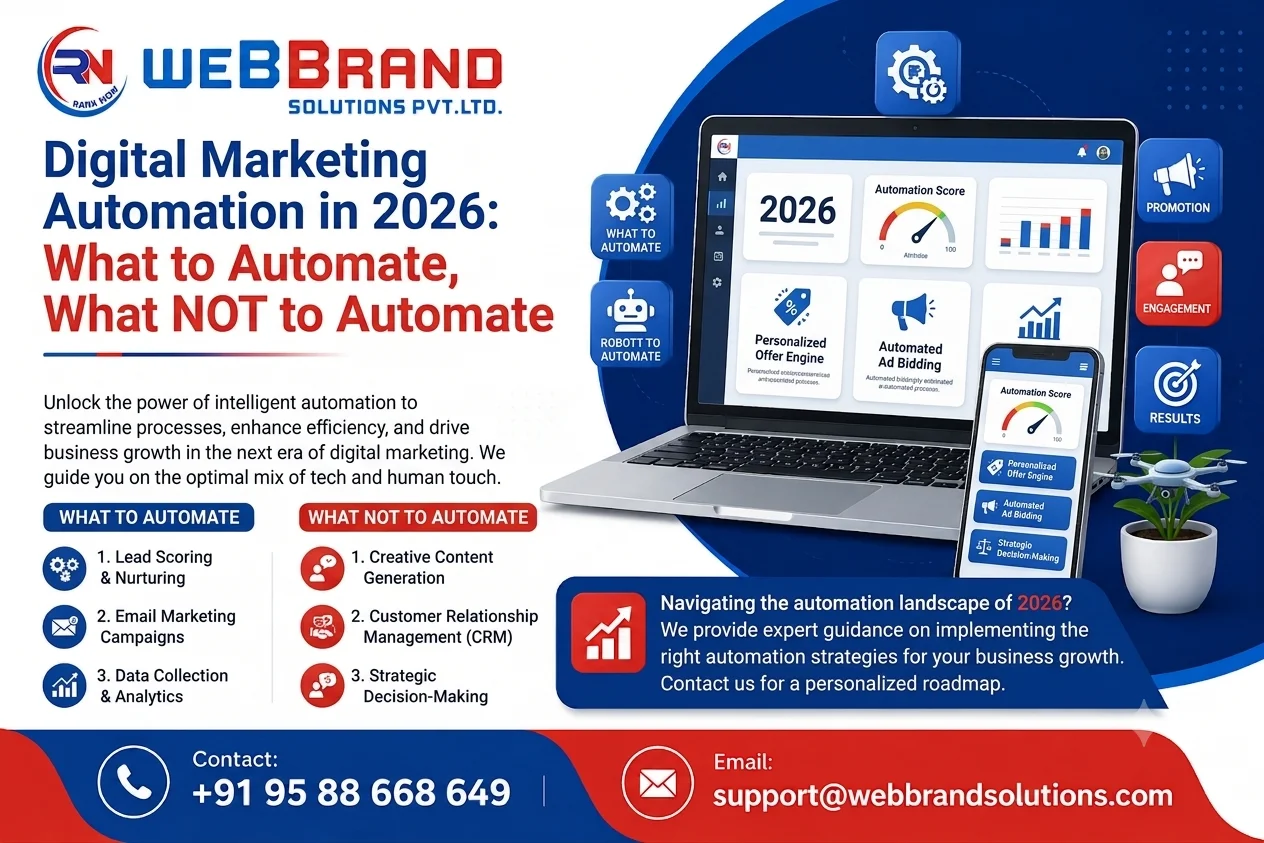
Automate repetitive tasks. Keep strategy, creativity, relationships and important decisions human-led.
Modern marketing automation can help businesses save time, respond faster, organize customer data, improve consistency and identify opportunities.
What Is Digital Marketing Automation?
Digital marketing automation is the use of software, workflows, AI and connected platforms to perform repetitive marketing tasks automatically based on predefined rules, triggers, data or customer actions.
For example:
A customer fills out a website enquiry form.
Instead of someone manually doing everything:
Form submission → Lead added to CRM → Automatic acknowledgement email → Lead assigned to salesperson → Salesperson receives notification → Follow-up reminder created → Lead status tracked
This is marketing automation.
The goal is not simply to reduce human involvement.
The goal is to make the marketing process faster, more consistent and easier to manage.
Why Digital Marketing Automation Matters in 2026
Customers expect businesses to respond quickly.
If someone submits an enquiry today, waiting two or three days for a response can mean losing the opportunity to a competitor.
Automation can help businesses:
- Respond faster
- Reduce repetitive work
- Organize leads
- Maintain consistent communication
- Schedule campaigns
- Monitor performance
- Segment customers
- Trigger follow-ups
- Generate reports
- Connect marketing platforms
- Reduce manual errors
AI is also making automation more sophisticated.
Instead of simple:
“If this happens → do that.”
modern workflows can increasingly involve:
Data → AI analysis → recommendation → human review → action
However, businesses should introduce automation according to their needs rather than automating everything simply because a new tool is available.
Digital Marketing Automation vs AI Automation
These terms are often used interchangeably, but they are not exactly the same.
Traditional Marketing Automation
Usually follows predefined rules.
For example:
If a customer downloads an ebook, send an email after one day.
The workflow is predictable.
AI-Assisted Marketing Automation
Can use AI to analyze information, generate content, summarize data or assist decision-making.
For example:
Analyze these 500 leads and identify which ones appear most likely to need our SEO services.
AI can help process the information and provide a recommendation.
The best modern systems often combine both:
Automation + AI + Human Oversight
The 80/20 Rule for Marketing Automation
A useful principle for businesses is:
Automate the process. Humanize the relationship.
For example:
| Marketing Activity | Automation Level | Human Involvement |
|---|---|---|
| Lead capture | High | Low |
| Email acknowledgement | High | Low |
| Social scheduling | High | Medium |
| Reporting | High | High for interpretation |
| Lead reminders | High | Medium |
| Content research | Medium-High | High |
| Content publishing | Medium | High |
| Customer complaints | Low | Very High |
| Brand strategy | Low | Very High |
| High-value sales | Low-Medium | Very High |
| Crisis communication | Very Low | Very High |
| SEO analysis | Medium | High |
| Ad optimization | Medium-High | High |
| Creative strategy | Medium | Very High |
The exact balance depends on the business.
Digital Marketing Automation for Small Businesses
You don’t need a large enterprise to benefit from automation.
A small business can start with five simple workflows.
Workflow 1: Website Lead
Form → Email → Notification → CRM
Workflow 2: Lead Follow-Up
New lead → Reminder → Follow-up → Sales stage
Workflow 3: Content
Topic → Research → Draft → Human review → Publish → Repurpose
Workflow 4: Customer Review
Completed service → Review request → Feedback
Workflow 5: Monthly Reporting
Data → Dashboard → Summary → Human analysis
These workflows can save significant manual effort without making the customer experience feel robotic.
The Biggest Automation Mistakes Businesses Make
Mistake 1: Automating a Broken Process
If your marketing process is confusing manually, automation may simply make the confusion happen faster.
Fix: Improve the process first.
Mistake 2: Buying Too Many Tools
More tools don’t automatically create better marketing.
Fix: Start with your business objective and workflow.
Mistake 3: Automating Everything
Customers can recognize robotic experiences.
Fix: Automate repetitive tasks and preserve human interactions.
Mistake 4: Ignoring Data Quality
Bad data produces bad automation.
For example:
Incorrect customer email → automated email failure
Wrong lead status → incorrect follow-up
Duplicate customer record → confusing communication
Fix: Maintain clean data.
Mistake 5: Forgetting Human Oversight
Automation needs monitoring.
Fix: Establish approval points for important actions.
Frequently Asked Questions (FAQs)
- What is digital marketing automation?
Digital marketing automation uses software, workflows, AI and connected platforms to automate repetitive marketing tasks such as lead capture, email campaigns, reporting, scheduling, customer segmentation and follow-ups. - What should businesses automate in digital marketing?
Businesses should prioritize repetitive, predictable and low-risk tasks such as lead notifications, email workflows, social scheduling, reporting, data synchronization and follow-up reminders. - What should businesses not automate?
Businesses should avoid completely automating high-value customer relationships, brand strategy, crisis communication, sensitive complaints, major business decisions, final creative decisions and other activities requiring human judgment. - Can AI replace digital marketers?
AI can automate and assist many marketing tasks, but digital marketing also requires strategy, creativity, customer understanding, brand positioning and decision-making. The stronger model is usually AI-assisted, human-led marketing. - Is marketing automation useful for small businesses?
Yes. Small businesses can start with simple workflows such as website lead capture, email acknowledgement, follow-up reminders, appointment notifications and monthly reporting. - How does automation improve lead generation?
Automation can capture leads immediately, send acknowledgements, notify sales teams, assign leads, create follow-up reminders and track lead stages. This can reduce delays and help businesses avoid missed opportunities. - Can SEO be automated?
Some SEO activities can be automated or AI-assisted, including reporting, keyword clustering, content research, technical monitoring and internal-link suggestions. SEO strategy, search intent, content quality and important decisions should still receive human oversight. - Is AI-generated content safe for SEO?
AI can assist with content creation, but businesses should not rely on mass-produced, low-value content. Content should be accurate, useful, relevant and created primarily for users. Human review and expertise are particularly important for important business claims and expert topics. - What is the biggest benefit of marketing automation?
The biggest benefit is not simply saving time. Effective automation can help businesses create a more consistent and measurable customer journey while allowing teams to spend more time on strategy, creativity and customer relationships. - How much marketing should a business automate?
There is no universal percentage. A useful principle is to automate repetitive, predictable and low-risk activities while keeping strategy, creativity, sensitive communication and high-value customer interactions human-led.
Conclusion: Automate the Work, Not the Relationship
Digital marketing automation will become increasingly important in 2026.
AI, CRM systems, analytics platforms, advertising platforms, email tools, websites and messaging systems can work together to reduce repetitive work and improve marketing efficiency.
At WebBrand Solutions, we help businesses build connected digital experiences through website design, SEO, digital marketing, social media, paid advertising, analytics and conversion-focused strategies.
If your team is spending too much time on repetitive marketing tasks, it may be time to identify what can be automated—and what should remain human.
Talk to WebBrand Solutions to build a smarter digital marketing system that saves time, improves efficiency and focuses on measurable business growth.