


SEO vs Google Ads: Which Is Better for Your Business in 2026?
SEO vs Google Ads—which one should your business invest in? This is one of the most common questions business owners ask when planning their digital marketing strategy.
The short answer is: neither SEO nor Google Ads is universally better. The right choice depends on your business goals, budget, competition, sales cycle, and how quickly you need results.
SEO can help a business build long-term organic visibility, while Google Ads can put your business in front of potential customers much faster. For many businesses, the strongest strategy is not choosing one over the other but using both strategically.
In this guide, we will compare SEO and Google Ads, explain their advantages and limitations, show when each strategy makes sense, and help you decide which approach is right for your business in 2026.
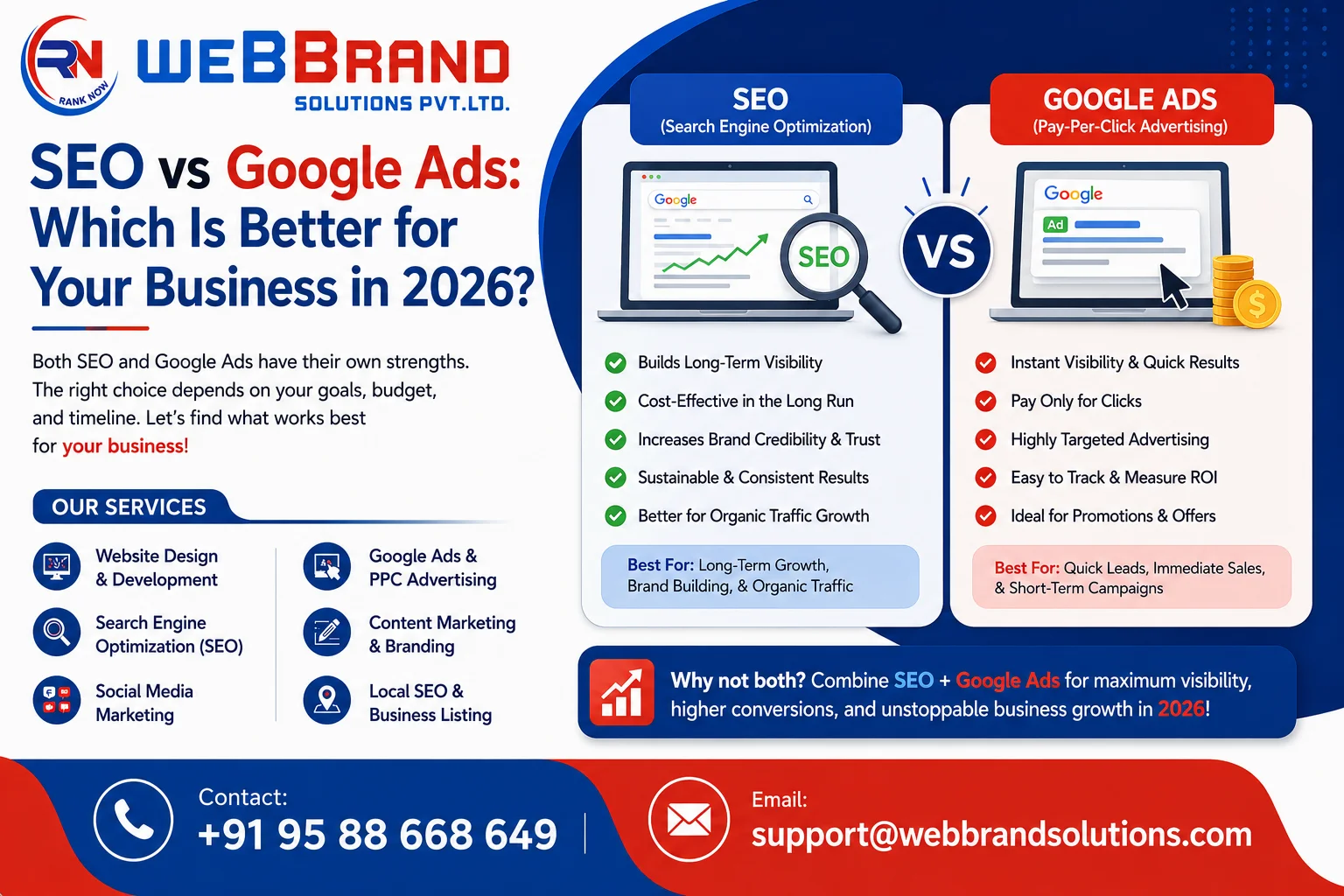
SEO vs Google Ads: Quick Answer
SEO is generally better for long-term organic traffic, authority, and sustainable visibility. Google Ads is generally better when you need targeted traffic and leads quickly.
A business with a long-term growth strategy may benefit significantly from SEO, while a new product launch, seasonal campaign, or urgent lead-generation requirement may benefit from Google Ads.
| Factor | SEO | Google Ads |
|---|---|---|
| Traffic type | Organic | Paid |
| Initial results | Usually slower | Usually faster |
| Long-term value | High | Depends on ongoing ad spend |
| Cost model | Investment in optimization/content | Pay for advertising clicks/interactions |
| Brand authority | Builds over time | Helps increase visibility |
| Targeting | Based on search intent and relevance | Strong audience, keyword and campaign targeting |
| Best for | Sustainable growth | Immediate visibility and leads |
| Works after stopping spend? | Organic visibility can continue | Paid traffic generally stops when campaigns stop |
The most effective digital marketing strategy often combines both.
What Is SEO?
Search Engine Optimization (SEO) is the process of improving a website and its content so that search engines can better understand, crawl, index, and rank its pages for relevant searches.
SEO can involve:
- Keyword research
- On-page SEO
- Technical SEO
- Content optimization
- Internal linking
- Local SEO
- Website performance improvements
- Structured data
- Digital PR and authority-building activities
- Conversion-focused content
For example, imagine a Pune-based website design company wants to attract businesses searching for “website designing company in Pune.”
Instead of paying for every click, the business can create and optimize a relevant page around that search intent and build organic visibility over time.
Why businesses invest in SEO
SEO can help businesses:
- Increase organic visibility
- Reach people actively searching for their products or services
- Build topical authority
- Generate long-term website traffic
- Improve brand credibility
- Create multiple entry points through content
- Support local search visibility
- Reduce dependence on paid traffic over time
However, SEO is not an overnight strategy.
Competitive keywords may require months of consistent technical optimization, content development, internal linking, authority building, and measurement before meaningful results appear.
What Are Google Ads?
Google Ads is Google’s advertising platform that allows businesses to promote products and services across eligible Google properties and advertising placements.
For search campaigns, advertisers can bid for opportunities to show ads when users search for relevant terms.
For example, someone searches:
“best digital marketing agency in Pune”
A business running an appropriate Google Ads campaign may have an opportunity to appear prominently for that search.
Google Ads can be useful when a company needs:
- Immediate visibility
- Qualified traffic
- Leads for specific services
- Product sales
- Campaign-specific landing pages
- Seasonal promotion
- New product exposure
- Location-focused advertising
The major difference is simple:
SEO aims to earn organic visibility, while Google Ads uses paid advertising to reach relevant audiences.
SEO vs Google Ads: Which Gives Faster Results?
If speed is the priority, Google Ads generally has an advantage.
A properly configured advertising campaign can begin generating impressions and clicks soon after it becomes eligible to serve.
SEO normally requires more time because search engines need to discover, crawl, index, evaluate, and rank content.
Consider this example.
Scenario 1: New business
A newly launched interior design company wants enquiries immediately.
Waiting for organic rankings may not be practical if the company has no established website authority.
Google Ads could provide an immediate acquisition channel while the business simultaneously builds its SEO foundation.
Scenario 2: Established business
A company has been operating for several years and receives consistent search demand for its services.
In this case, investing in SEO can create significant long-term value because the company can build visibility around multiple relevant searches instead of paying for every visit.
SEO vs Google Ads: Which Is More Cost-Effective?
There is no universal answer.
The cost-effectiveness of SEO or Google Ads depends on:
- Industry
- Keyword competition
- Customer lifetime value
- Conversion rate
- Average order value
- Sales cycle
- Advertising costs
- SEO investment
- Website quality
- Landing-page experience
- Conversion optimization
For Google Ads, one useful calculation is:
Cost per lead = Total advertising spend ÷ Number of qualified leads
For example:
If a campaign spends ₹30,000 and generates 60 qualified leads:
₹30,000 ÷ 60 = ₹500 per qualified lead
But the real question should not be only “How much did the lead cost?”
You should also ask:
How many leads became customers, and how much revenue did those customers generate?
A campaign generating inexpensive but poor-quality leads may be less valuable than a campaign generating fewer but highly qualified prospects.
Is SEO Free?
This is a common misconception.
Organic clicks do not require a per-click advertising payment, but professional SEO still requires investment.
Businesses may invest in:
- SEO strategy
- Content creation
- Keyword research
- Technical SEO
- Website development
- Design improvements
- Analytics
- Conversion optimization
- Digital PR
- Local SEO
- Ongoing content updates
So SEO should be viewed as a long-term marketing investment, not “free traffic.”
Which Is Better for Small Businesses?
For many small businesses, the answer depends on how quickly they need customers.
Choose SEO when:
- You want sustainable organic growth.
- Your customers regularly search for your services.
- You want to build authority.
- You have a longer growth horizon.
- You want to attract traffic through informational and commercial searches.
- Your business serves a defined local market.
- You want to reduce dependence on paid acquisition over time.
Consider Google Ads when:
- You need leads quickly.
- You are launching a new service.
- You have a strong offer.
- You have measurable conversion goals.
- You want to target specific locations or search intent.
- You are running a limited-time promotion.
- You have enough margin to support paid acquisition.
What About Local Businesses?
Local businesses can benefit from both SEO and Google Ads
Suppose you operate a dental clinic in Pune.
Potential searches might include:
- Dentist near me
- Best dentist in Pune
- Dental clinic in Wakad
- Root canal treatment in Pune
- Cosmetic dentist near me
Your strategy could include:
SEO
Optimize your website and local presence for relevant services and locations.
Google Ads
Run targeted campaigns for high-intent searches where immediate visibility can generate enquiries.
Website
Create dedicated service pages with:
- Clear service information
- Location information
- Contact options
- Phone number
- Appointment CTA
- FAQs
- Trust signals
- Relevant images
The website becomes the bridge between traffic and conversion.
Why Your Website Matters More Than You Think
Whether traffic comes from SEO or Google Ads, users eventually need a reason to trust your business.
A poorly designed website can waste both organic and paid traffic.
Imagine spending ₹50,000 on advertising but sending visitors to a slow website with:
- Confusing navigation
- Weak content
- No clear CTA
- Poor mobile experience
- Difficult contact forms
- Missing trust signals
The advertising may generate clicks, but clicks alone do not generate revenue.
Your website should answer three questions quickly:
What do you offer?
Why should I trust you?
What should I do next?
That is why SEO, paid advertising, website design, UX, and conversion optimization should not be treated as completely separate activities.
Can SEO and Google Ads Work Together?
Absolutely.
In fact, using both can create a more complete search marketing strategy.
For example:
Google Ads → immediate traffic
SEO → long-term organic visibility
Website → conversion
Analytics → measurement
Content → authority and discovery
This creates a marketing ecosystem rather than relying on a single traffic source.
Google’s current guidance also emphasizes that foundational SEO remains important for Google’s AI search experiences, including AI Overviews and AI Mode. Google recommends focusing on technically accessible websites and helpful, reliable, people-first content rather than chasing special “AI SEO” tricks.
SEO, AEO and GEO: What Should Businesses Focus On in 2026?
Search is becoming more conversational.
People increasingly ask questions rather than entering only short keywords.
Instead of:
“SEO agency Pune”
a user might ask:
“Which SEO agency in Pune can help a manufacturing company generate B2B leads?”
This means businesses should create content that clearly answers real customer questions.
AEO — Answer Engine Optimization
AEO focuses on making information easy for answer engines and search experiences to understand and surface.
Useful practices include:
- Direct answers
- Question-based headings
- FAQs
- Clear definitions
- Structured content
- Concise explanations
- Supporting evidence
GEO — Generative Engine Optimization
GEO is commonly used to describe efforts aimed at improving visibility in generative AI search experiences.
However, Google says there are no special additional technical requirements specifically for AI Overviews or AI Mode. Its guidance recommends continuing to follow fundamental SEO practices and creating unique, valuable, people-first content.
Therefore, businesses should not create content simply because it contains the words “AI,” “AEO,” or “GEO.”
The goal should be to create content that genuinely helps customers.
Frequently Asked Questions (FAQs)
- Is SEO better than Google Ads?
Neither is universally better. SEO is generally better for building long-term organic visibility, while Google Ads can provide faster paid visibility. The right choice depends on your goals, budget, competition, and customer acquisition model. - How long does SEO take to show results?
SEO timelines vary considerably by website authority, competition, technical condition, content quality, search demand, and industry. Businesses should treat SEO as an ongoing growth strategy rather than expecting guaranteed results within a fixed number of days. - Can Google Ads replace SEO?
Google Ads can complement SEO, but it does not replace organic search visibility. Paid campaigns generally depend on continued advertising investment, while SEO aims to build organic visibility. - Is Google Ads expensive?
The cost depends on factors such as competition, targeting, industry, campaign quality, bidding, and conversion performance. Instead of focusing only on click costs, businesses should evaluate cost per qualified lead and return on advertising investment. - Should a new business start with SEO or Google Ads?
A new business can consider both. Google Ads may help generate visibility and enquiries sooner, while SEO can build long-term organic visibility. - Does SEO still matter with AI search?
Yes. Google states that its AI search experiences are built on core Search systems and that existing SEO fundamentals remain relevant. Google recommends helpful, reliable, people-first content and does not require special “AI SEO” technical requirements for AI Overviews or AI Mode. - What is more important: SEO, Google Ads or website design?
They solve different problems. SEO and Google Ads help bring visitors, while website design and conversion optimization help turn those visitors into enquiries or customers. Strong results usually come from making these elements work together.
Final Takeaway: Build a Search Strategy, Not Just a Traffic Strategy
SEO and Google Ads are not competitors that businesses must always choose between.
They are different tools designed to solve different marketing problems.
SEO builds long-term organic visibility.
Google Ads provides targeted paid visibility.
Your website converts that visibility into business opportunities.
Analytics tells you what is actually working.
For businesses competing in an increasingly complex search environment, the goal should not simply be to “get more traffic.” The goal should be to attract the right audience, answer their questions, earn their trust, and convert their interest into measurable business growth.
At RN Webbrand Solutions, we help businesses build their digital presence through SEO, digital marketing, website design, web development, paid search, analytics, and conversion-focused strategies. Our approach is focused on connecting visibility with real business objectives rather than chasing traffic numbers alone.
Want to know whether SEO, Google Ads, or a combination of both is right for your business? Contact WebBrand Solutions and let’s build a digital marketing strategy around your actual growth goals.